

I stumbled upon this post in a slack community three weeks ago.
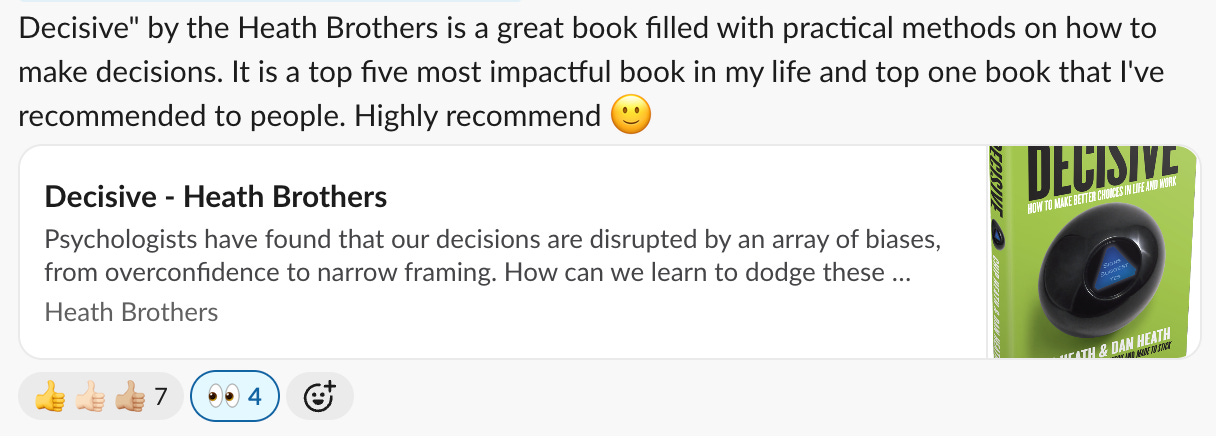
Decisions are all around us, all the time. Getting better at them will have more leverage on your life than each topic we share here in isolation. So in the spirit of other meta-posts we did in the past on habit building and skill mastery, I’ll summarize their framework here for an 80/20 on decision making.
Tried something new again this week - animated the post with AI, turned out better than expected, though not perfect. Let me know what you think!
How to make decisions
The Heath brothers start out by explaining why we’re bad at decisions: We only focus on what’s in the spotlight, frame too narrowly, seek confirmation bias (only look for evidence that confirms our beliefs), are driven by short-term emotions, and are overconfident in our predictions.
To fix it, they propose this four-step process. Try it out by taking a decision you’re working through right now and applying the questions to your decision as you go.
1. Generate options
Most decisions initially look like yes/no questions. According to studies they cite, this applies to both teenagers and organizations: 70% of decisions by both groups only consider one option, and it leads to bad outcomes. Generate more options by:
Generate with reframes: Consider opportunity costs - what else could you do with the time/money? Try the vanishing options test - what would you do if the option disappeared?
Find people who solved your problem: Outside: Competitors, benchmarking, best practices, AI brainstorms. Inside: Employees, situations where you solved your problem, methods that worked for you in the past. Up: Analogies.
Evaluate in parallel: Prevents your ego from favoring one. Beware of sham options by making sure smart people disagree. Avoid decision paralysis by limiting to a few. Switch between avoiding downsides and pursuing upsides. Try A AND B vs OR.
2. Test assumptions
When looking for evidence to confirm/disconfirm the options we generated, we tend to look for information that supports our initial assumptions. This is called confirmation bias. To combat confirmation bias, apply these ideas:
Consider the opposite: Encourage constructive disagreement in teams, ask disconfirming questions (or open-ended if power dynamics present), try doing the opposite, build discipline/habit to seriously consider “what if I’m wrong”.
Zoom out, zoom in: Zoom out: how things unfold on average. We usually don’t give it enough weight. To get outside averages, ask experts (they’re great at base rates but terrible at predictions). Then sample your specifics up close for texture.
Experiment: Dip your toe before jumping headfirst. Generates lots of data without risk of full commitment. Entrepreneurial mindset: Just try things and see what sticks. Try to make explicit what you want to learn in the experiments.
3. Distance yourself
Fleeting emotions can tempt us to make decisions we’ll regret. Careful with status quo bias: a combination of mere exposure (we like what we know) combined with loss aversion (losses are more painful than gains are pleasant). Get distance to avoid.
Overcome short-term emotions: Try 10/10/10: how would you feel about this in ten weeks, ten months, ten years? Try using an observer’s perspective: What would my successor do? What would I tell my best friend?
Honor core priorities: Agonizing decisions are often conflicts among core priorities (values, goals, aspirations). Explicitly rank them, then decide what not to do, what to deprioritize, and build a habit to review actions against priorities.
4. Minimize risk
No matter what decision you make, you’ll be wrong in some ways. We can’t predict the future, but we can take actions to minimize the fallout when things don’t go as planned.
Think in scenarios: Consider a range of outcomes and anticipate problems: Try a premortem: “A year from now our decision failed - why? It was a great success - can we deal with it?” Add a margin of safety / plan with buffers.
Set a tripwire: It’s easy to slip into autopilot, especially when change is gradual. Build in tripwires to force making a choice. Tripwires are: Deadlines, budgets (time, money, resources), go/no-go gates, processes for pattern recognition.
Trust the process: Group decision making needs to be fair to get acceptance on the final decision. Bake these steps into a process that works within your life/team/organization. Link it to existing triggers.

Three things to start on making better decisions
Stop for ten seconds: What’s your top decision to make right now?
Block time in your calendar to use this process on your top decision.
Check: How can you make sure you check this post next time you make a decision?
Missing something? Thoughts or feedback? Add a comment and we’ll add it to next year’s version